Tools like Ascribe Coder have long been the standard for coding open-ended survey responses in market research, helping manual coders work more efficiently and organize feedback through structured codebooks.
But as research timelines shrink and workloads grow, this traditional approach to verbatim analysis often becomes the slowest part of the project.
Therefore, many research teams are now looking for Ascribe alternatives, tools that bring speed and clarity to their verbatim analysis without relying fully on manual coding. They’re looking for AI-assisted platforms that fit smoothly into the research process, handle large volumes of open-ended responses, and keep quality at the level clients and stakeholders expect.
In this guide, we’ll highlight the best alternatives for researchers who need advanced open-ends analysis tools built for market research. These platforms reduce the operational burden of traditional coding and move teams toward the next generation of insight production.
Why Are Researchers Exploring Alternatives to Ascribe?
Ascribe has been a longstanding tool in the market research space, especially for teams that rely on experienced manual coders. Many researchers trust it because it has been part of their stack for years and was designed with professional coders in mind.
That said, Ascribe was built for a different era of text analysis. The platform still depends heavily on manual effort, and modern research teams often need faster turnaround times, simpler interfaces, and stronger automation.
As projects grow in size and language complexity, more agencies are evaluating newer platforms that can keep up with current expectations.
Common reasons researchers look for Ascribe alternatives include:
- Time demands: Coding with Ascribe still requires extensive manual effort and time.
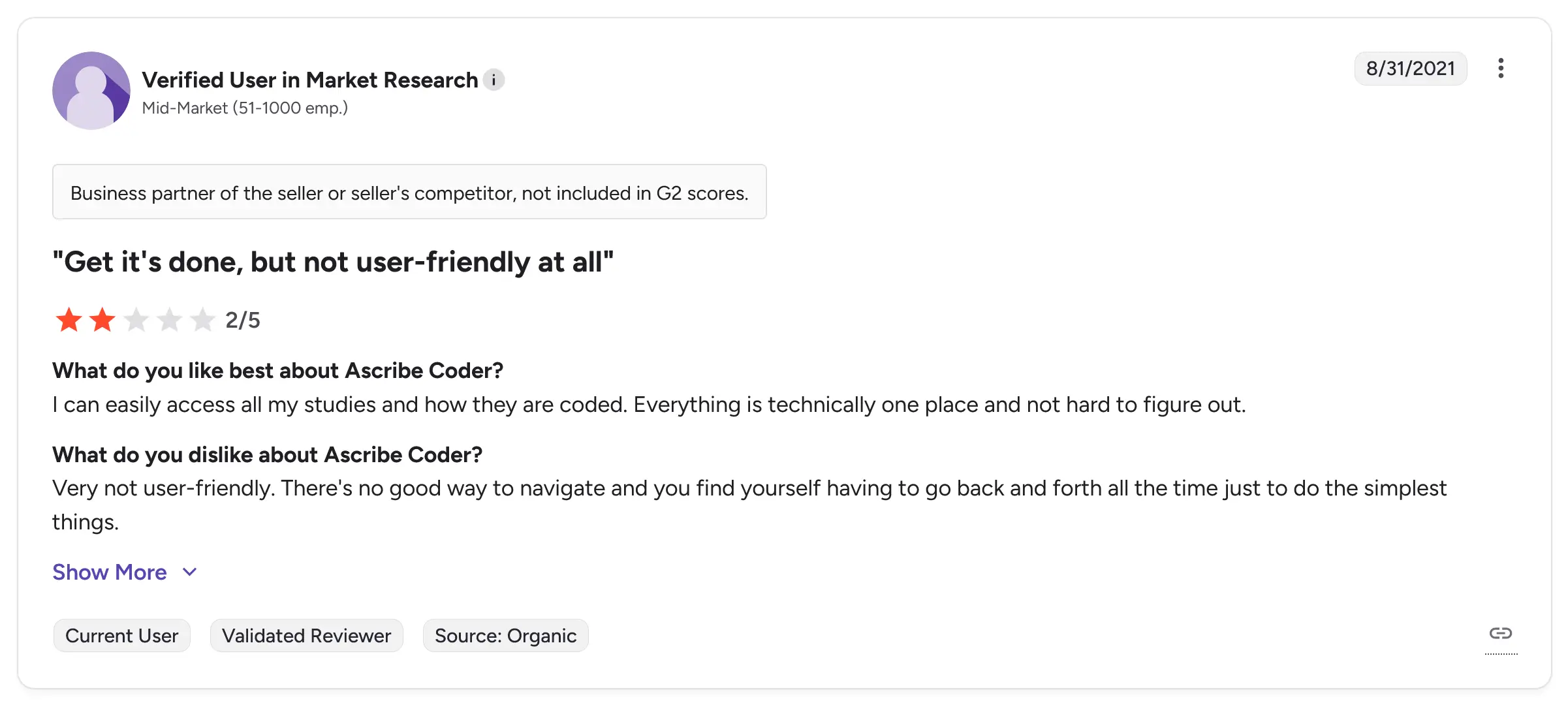
- Not user-friendly: The system isn’t intuitive and often requires lengthy training before teams feel confident using it.
- Older automation methods: Most of Ascribe’s automation features rely on keyword-based logic and older ML techniques rather than modern LLMs, which limits accuracy and requires close supervision to ensure quality.
- Language limitations: Not all languages are fully supported. For global studies, teams often need to translate open-ends first, adding cost, time, and risk of losing nuance.
- Pricing structure: Costs are based on the number of codes applied per response, making it hard to estimate project pricing upfront.
One user on G2 described it as “very not user friendly”:
Best Ascribe Alternatives for Open-Ended Survey Text Analysis
1. Blix.ai - Best Overall Alternative to Ascribe
Blix is the strongest alternative for teams that want fast, accurate, and easy AI-driven analysis of open-ended survey responses without the heavy manual workload common in older systems like Ascribe. It’s built specifically for market researchers that handle large volumes of open-ended survey responses and need high-quality verbatim coding that matches human-level accuracy.
The platform focuses on speed, clarity, and easy day-to-day use. Researchers can instantly generate insights with one click, adjust codeframes with full control, and work across languages without relying on outside translation services. Its design supports the fast pace and expectations of modern market research.
Pros:
- Fast AI-driven coding: Full control to edit, merge, or adjust the codeframe.
- Meaning-based coding: Interprets slang, emojis, and casual or unstructured language.
- Modern UI: Low learning curve with a clear, simple layout.
- Works in any language: Supports global studies without extra translation steps.
- Real-time summary reports: Charts and patterns appear instantly to help surface insights.
Con:
- Fewer integration options: Limited direct connections with survey platforms.
Looking for an Ascribe alternative?
Book a demo and see how Blix delivers high-quality coding in minutes
2. Qualtrics Text iQ
Qualtrics Text iQ is part of a large, established ecosystem that many market research teams already know. It offers strong analytics within the broader Qualtrics platform, but it often requires extensive setup, carries a steep learning curve, and sits at a price point that can be challenging for smaller teams that only need text analysis rather than the full suite.
Pros:
- Connected to the Qualtrics survey platform: Direct access to collected survey data.
- Stable, enterprise-ready environment: Built for large organizations and long-term use.
- Transparent data governance and compliance: Clear controls for managing sensitive information.
- Lots of integrations: Broad connections across the wider Qualtrics ecosystem.
Cons:
- Low-quality keyword-based coding: Often misses sentiment or nuance in open-ends.
- Steep learning curve and UI complexity: Requires significant time to master.
- High pricing: Can be difficult for smaller teams to justify.
- Limited flexibility for non-survey text sources: Best suited only for Qualtrics inputs.
- Reporting can feel rigid: Less adaptable than newer platforms built for faster iteration.
3. Codeit
Codeit is a straightforward coding tool designed mainly for manual coders in market research. While the platform is accessible and practical for manual workflows, it lacks the newer AI capabilities many agencies now expect for large projects or tight timelines.
Pros:
- Built for market research coding: Designed around industry-standard coding practices.
- Lots of functionality for manual coders: Offers tools that support hands-on coding workflows.
- Accessible pricing: More affordable for teams with smaller budgets.
Cons:
- Heavy manual work: Still centered on manual coders rather than researchers who need faster turnaround.
- Lower coding quality: Uses older ML methods instead of newer language models.
- Outdated UX: The interface can feel older compared to modern platforms.
- No advanced AI features: Limited automation for large or complex datasets.
4. MAXQDA
MaxQDA is a long-standing qualitative analysis tool widely used in academic and professional research. It’s well suited for teams that want deep manual control over coding and need to work closely with interview transcripts, focus groups, or mixed-methods projects.
While it offers extensive flexibility for qualitative work and some basic AI features, it’s not optimal for fast-moving survey text analysis or high-volume datasets.
Pros:
- Robust manual coding workflows: Strong tools for hands-on qualitative coding.
- Ideal for detailed qualitative analysis: Helpful when human nuance is essential.
- Strong academic credibility: Commonly used in research institutions.
- Supports many file formats and multimedia: Useful for complex qualitative projects.
Cons:
- Not optimized for survey text at scale: Slower for high-volume open-ends work.
- Significant learning curve: New users may need time to get comfortable.
- Non-intuitive interface: Navigation can feel dated.
Limited automation: Fewer advanced AI capabilities compared to newer platforms.
5. Atlas.ti
Atlas.ti is a well-established qualitative research platform known for its depth, academic usage, and strong manual coding features. It offers a more modern interface than some older qualitative tools and includes helpful visualization options.
Even so, it remains a manual-first system, which can slow teams down when working with large sets of survey responses.
Pros:
- Strong qualitative depth for manual coders: Well suited for detailed, hands-on analysis.
- Detailed visual tools: Includes networks, maps, and other visualization features.
Cons:
- Slower than AI-native tools: Manual workflows make it difficult to process large volumes of survey responses quickly.
- Limited automation: Current automation features are early and not comprehensive.
- Not ideal for fast agency workflows: Manual processes can delay delivery timelines.
- Complex setup for structured codebooks: Requires more planning before analysis begins.
Side-by-Side Feature Breakdown
Ready to Choose an Ascribe Alternative?
Ascribe still works for manual coding, but many market research teams are running into the same roadblocks: long hours spent building and adjusting codeframes, slow hand-coding on large datasets, and tools that take too much training before anyone feels confident using them.
As workloads grow, researchers are looking for platforms that help them move faster without sacrificing clarity or quality.
If you’re tired of putting in hours of manual work on large projects and want a tool your team can pick up quickly, Blix gives you that support. It offers fast, meaning-based coding with human-level accuracy and clear summary findings that help you go from open-ended text to usable insights with just one click.
For researchers who want speed, clarity, and high-quality results, Blix delivers the most complete upgrade from manual-first tools.