Your customers are already pointing out exactly where your business could be better. The question is whether you're listening.
Not surprisingly, companies that prioritize customer experience grow revenue 80% faster than their competitors.
What separates successful companies from the rest isn't budget or headcount; they've built a consistent customer feedback loop that turns customer voices into real improvements, again and again.
In this guide, we'll break down each stage of the customer feedback loop, why it matters for customer retention and product quality, and how to build one that improves customer satisfaction overall.
What Is a Customer Feedback Loop?
A customer feedback loop is not a one-time survey or a quarterly review. It's the operational backbone of any Voice of the Customer (VoC) strategy, connecting the data you collect to the decisions you make. It's a cycle with four distinct stages:
- Collect: Gather feedback from the places your customers are already talking, such as surveys, online reviews, and social media.
- Analyze: Look for patterns and themes to uncover what customers are telling you beneath the surface.
- Act: Make tangible changes based on what you find, whether that's fixing a recurring product issue, streamlining a clunky process, or adjusting how your team communicates with customers.
- Close the loop: Follow up with customers via email, phone, or socials to let them know their feedback led to real change.
Benefits of a Customer Feedback Loop
When done right, a customer feedback loop makes your business stronger. Here's what you can expect when you close the loop consistently:
- Better product decisions: Instead of relying on assumptions or internal opinions, you're building and improving based on what customers need. This means fewer wasted resources on features that miss the mark and more investment in what drives value.
- Reduced churn: When customers feel heard and see their feedback translated into action, they're less likely to leave. Retaining an existing customer is significantly cheaper than acquiring a new one.
- Stronger client relationships: Closing the loop shows customers that you're paying attention. This builds trust and loyalty, which can turn one-time buyers into long-term advocates who are more likely to refer others to your business.
- Improved customer experience: Feedback surfaces friction points you might not even know exist. Addressing them consistently leads to a more satisfying experience that keeps customers coming back.
The 4 Steps of a Customer Feedback Loop
A successful feedback loop follows four clear stages. Here's how each one works in practice.
1. Step 1 - Collect Customer Feedback
The first step is gathering feedback from the right places. Here’s a list of ways you can collect feedback to understand how your customers think and feel about your brand, products, or services.
Surveys
Send out structured surveys after key customer moments, like a purchase, a support interaction, or the end of an onboarding session. Common formats include Net Promoter Score (NPS) to measure loyalty, Customer Satisfaction Score (CSAT) to gauge satisfaction at a specific touchpoint, and Customer Effort Score (CES) to understand how easy it is for customers to get what they need.
Customer Support Interactions
Your support team is sitting on a goldmine of feedback. Support tickets, live chat conversations, and call transcripts reveal the recurring pain points and frustrations that customers experience day to day.
Product Feedback
In-app feedback forms, feature requests, and bug reports tell you exactly where your product is falling short or where customers want it to go next.
Customer Conversations
Sales calls, customer success meetings, and onboarding sessions are rich sources of unfiltered feedback. These conversations often surface insights that customers wouldn't bother writing down in a survey.
Public Feedback Sources
Monitoring online reviews, social media comments, and community forums is a form of social listening. It can show you what customers are saying about you when they think no one from your company is listening, which is often the most honest feedback you'll get.
Open-Ended Survey Responses
Beyond ratings and scores, open-ended questions let customers share, in their own words, what’s driving their experience and how they truly feel, giving you the qualitative context behind the numbers.
2. Step 2 - Analyze the Feedback
Once you've gathered feedback from these sources, the real work begins: making sense of it all. For market researchers, CX teams and consumer insights teams, having a scalable analysis process is critical. Customer feedback comes in different forms, and each requires a different approach.
Quantitative Feedback
Quantitative feedback includes the numerical scores and ratings you've collected, such as your NPS, CSAT, and CES scores, structured survey responses, and scale-based answers. This data is relatively straightforward to measure and track over time.
To analyze it, start by pulling your scores into a dashboard or spreadsheet where you can view them side by side across time periods, customer segments, and touchpoints. Most survey tools and CX platforms will export this data directly, making it easy to see patterns at a glance.
Once your data is organized, look for:
- Trends over time: Is your NPS score climbing or dropping quarter over quarter? A consistent decline is a signal that something in the experience is slipping.
- Scores by segment: Break your data down by customer type, product category, or specific interaction touchpoint. A low CSAT score specifically after onboarding, for example, tells you exactly where to focus your attention.
- Volume and frequency: How many customers are reporting the same issue? The more widespread a problem is, the higher it should sit on your priority list.
From this data, you can draw conclusions like: "Customers who go through our onboarding process are significantly less satisfied than those who don't, suggesting we need to rethink that experience."
Qualitative Feedback
Numbers tell you where the problem is, while your qualitative feedback tells you why it's happening. This includes the open-ended responses from your surveys, the comments left in online reviews, the recurring complaints in support tickets, and the candid moments from customer interviews. Together, they give context to everything your scores are flagging.
Analyzing this type of feedback at scale can be challenging, especially when you're dealing with hundreds or thousands of responses. This is where AI-powered text analysis becomes valuable. Rather than reading through every response manually, you can use tools like Blix to:
- Eliminate manual work: Automatically code thousands of open-ended responses in minutes.
- Get to insights faster: Quickly surface recurring themes and priority issues across your entire dataset.
- Navigate results with ease: Blix presents findings in a clean, visual format that anyone on your team can understand and act on, no technical expertise required.
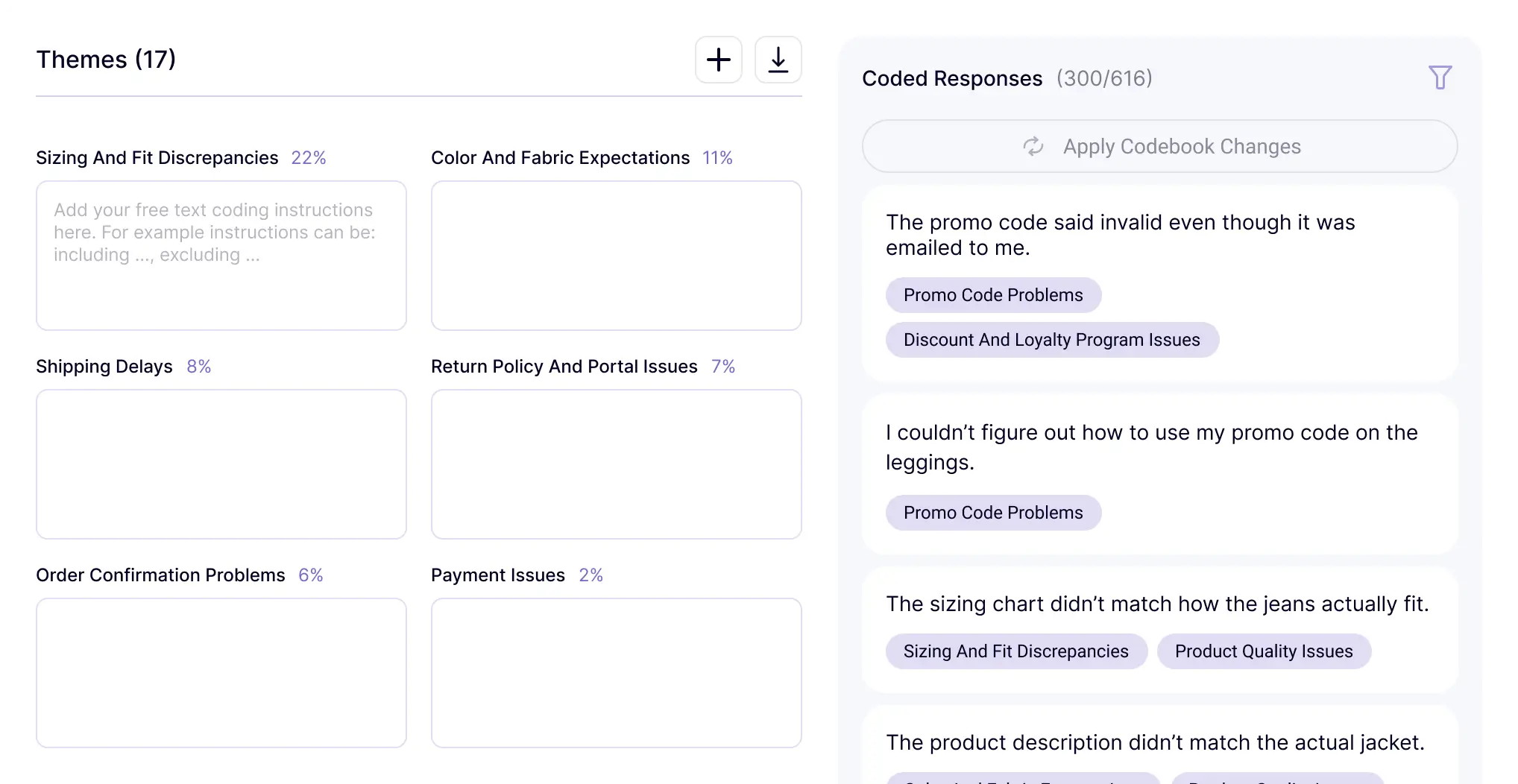
From this analysis, you might conclude: "Customers consistently mention feeling confused during the pricing stage of their journey, which explains the drop in our CSAT scores at that touchpoint."
The goal of this step is to translate both your numbers and your customers' words into clear, actionable insights that your team can act on.
Turn thousands of customer comments into clear, actionable insights in minutes.
3. Act on the Feedback
Insights only matter when they drive action. Once you know what your customers are telling you, there are several ways to respond depending on what the feedback reveals:
- Fix product issues: Address recurring bugs, usability problems, or missing features.
- Improve onboarding or documentation: If customers are consistently confused early on, that's a sign your onboarding process or support materials need attention.
- Adjust your messaging: If customers misunderstand what your product does or what it offers, that's a marketing problem worth solving.
- Update support processes: If the same questions keep coming in, it may be time to retrain your support team or improve your self-service resources.
- Track what changes: Keep a record of what actions were taken and when, so you can measure whether those changes made a difference.
4. Close the Loop (Follow Up)
Closing the loop means letting customers know that their feedback was heard and that it led to changes. Here's how to do it:
- Respond directly: If a customer submitted feedback personally, follow up with them individually to acknowledge it and share what's changed as a result.
- Send product update emails: Let your broader customer base know about improvements you've made, especially when those changes were driven by their input.
- Notify customers when their requests are implemented: If a customer asked for a specific feature and you built it, tell them.
- Publish changelogs or update notes: Keep a running record of product improvements that customers can reference at any time.
- Share insights internally: Make sure every team knows what customers said and how the business responded, so everyone stays aligned.
Challenges of Customer Feedback Loops
Building a feedback loop sounds straightforward, but in practice there are a few common roadblocks that get in the way. Here's what to watch out for and how to overcome them.
Low Response Rates
Customers don’t always take the time to respond to surveys or feedback requests, especially if they’re long, poorly timed, or feel irrelevant. This leads to incomplete data and biased insights based only on highly motivated respondents (often the happiest or most frustrated).
Solution: Keep surveys short, trigger them at the right moment (e.g., right after an interaction), and clearly communicate the value of responding. Incentives can also help boost participation, such as discounts, promo codes, or giveaways.
Lack of Clear Ownership
When no one is specifically responsible for managing and acting on customer feedback, it quickly falls through the cracks. Feedback might be collected by one team (like CX or marketing), but the changes needed sit with product, operations, or leadership. Without defined ownership, insights get deprioritized or forgotten entirely.
Solution: Assign clear ownership at both levels: someone accountable for managing the feedback loop itself (collection, analysis, reporting) and specific owners for acting on insights within each department. Pair this with regular check-ins or reporting so feedback consistently drives decisions.
Feedback Overload
When feedback is coming in from multiple sources at scale, the volume can quickly become overwhelming. Hundreds of open-ended survey responses, thousands of reviews, stacks of support tickets, and mountains of numerical scores and ratings all pile up at once.
Solution: For open-ended responses, use text analysis tools to automatically group feedback into themes so you're not reading through every comment manually.
For quantitative data, customer feedback platforms like SurveyMonkey allow you to centralize your scores, such as NPS, CSAT, and CES, and visualize trends over time in one place, so you're not manually compiling results from multiple sources.
Slow Analysis Processes
Manual coding and review of open-ended responses takes time. But so does compiling, cleaning, and making sense of quantitative data from multiple platforms. By the time insights are ready, the window to act on them may already be gone.
Solution: Automate the analysis of open-ended responses with AI-powered text analysis tools, and use integrated dashboards that pull your quantitative data together automatically, so your team can move from data to decisions in a fraction of the time.
Difficulty Turning Insights Into Action
Even when feedback is analyzed, both the themes from qualitative responses and the trends from quantitative scores, it often doesn't translate into change because no one owns the follow-through. Insights get shared in a report, and then nothing happens.
Solution: Assign clear ownership for feedback-driven improvements, prioritize issues based on frequency, impact, and customer sentiment, and track what changes have been made as a direct result of customer feedback.
Manual feedback analysis slowing your team down? Blix saves your team hours of work with fast, automated text analysis
Best Practices for Building a Strong Customer Feedback Loop
Here are the practices that separate businesses that truly learn from their customers from those that just go through the motions:
- Collect feedback continuously, not just once a quarter: Customer sentiment changes constantly. Building regular touchpoints into your process means you're never caught off guard by a problem that's been brewing for months.
- Combine your numbers with your customers' words: Quantitative scores tell you where something is wrong. Qualitative responses tell you why.
- Focus on recurring themes, not one-off comments: A single complaint might be an outlier. The same complaint showing up across hundreds of responses is a signal worth acting on.
- Respond to customers quickly: The faster you acknowledge feedback, the more valued customers feel. Even a simple "we heard you and here's what we're doing about it" builds significant trust.
- Use technology to analyze feedback at scale: Manual analysis doesn't scale. AI-powered text analysis tools like Blix allow you to process large volumes of feedback quickly, so insights are always current and actionable.
Building a Customer Feedback Loop That Drives Better Decisions
A customer feedback loop is one of the most powerful tools a business can have. When you collect feedback consistently, analyze it properly, act on what you find, and close the loop with your customers, you create a cycle that continuously improves your product, your experience, and your relationships.
The hardest part for most teams is making sense of feedback at scale, especially when it comes to open text. That's where Blix comes in. Blix helps market research and insights teams analyze large volumes of open-ended customer feedback quickly, turning thousands of responses into clear themes and actionable insights in minutes.
our customers are already telling you what matters. Blix helps you find the patterns faster with AI-powered analysis