You're getting more feedback than ever: comments, reviews, replies, DMs, and mentions. The volume isn't the problem. The issue is figuring out what any of it truly means. Are people talking about your brand because they love it or because something went wrong? That's exactly what social media sentiment analysis helps you uncover.
In this guide, we go over what sentiment analysis is, why it matters, and how to put it to work without needing a technical background to get started.
What Is Social Media Sentiment Analysis?
Social media sentiment analysis is the process of analyzing posts, comments, reviews, and replies to determine the emotion behind them. That emotion is typically categorized as positive, negative, or neutral, though more advanced analysis can also detect specific feelings like anger, joy, fear, or disgust.

It's applicable across a wide range of use cases, including:
- Brand health monitoring to track how your reputation shifts over time
- Campaign tracking to see how audiences are responding to your content
- Competitor analysis to understand how your brand stacks up in the conversation
- Customer feedback to surface recurring pain points and wins
Turn messy social media text into clear, sentiment-driven insights with Blix
How Does Sentiment Analysis Differ From Social Media Monitoring?
These two terms get used interchangeably a lot, but they're not the same thing. Social media monitoring tracks what is being said, things like mentions, tags, keywords, and the overall volume of conversation around your brand. It answers the question, "Are people talking about us?"
Sentiment analysis goes a layer deeper. It looks at the emotion and intent behind those mentions to tell you how people feel, not just that they're talking.
Benefits of Social Media Sentiment Analysis
When used consistently, sentiment analysis becomes one of the most practical tools you have for making better decisions across your entire brand. Here's what it leads to.
Smarter Product Decisions
When you know what people love about your product, you can lean into it. When you know what's frustrating them, you can fix it. Streaming platforms, for example, use sentiment analysis to track how audiences are responding to their content, using that feedback to decide what to greenlight, pull back on, or invest more heavily in going forward.
More Effective Marketing
The topics and themes that consistently generate positive sentiment are signals for what your audience wants more of. It also shows you the specific language your audience uses, so your messaging can mirror how they naturally talk about things rather than how you assume they do.
Proactive Reputation Management
This is where sentiment analysis can really save you. When Jaguar unveiled their rebrand in 2024, social media lit up almost immediately, with customers calling it "horrible" and "awful." Brands that track sentiment in real time can catch that kind of reaction early and respond before it spirals, whether that means addressing the feedback publicly, adjusting the direction, or doubling down with more context and communication.
Competitive Intelligence
Sentiment around competitor brands can reveal gaps and opportunities in the market. If their audience is consistently frustrated about something, that's a signal worth paying attention to. For instance, a retail brand that notices a flood of negative comments about a competitor's return process has a clear opening to highlight how easy their own return experience is.
How To Run Social Media Sentiment Analysis Research (Step-by-Step)
Whether you're tracking how a campaign landed or trying to understand why customers are frustrated, the process follows a clear path. Here's how to do it.
Step 1: Define Your Objectives
Before you collect a single data point, you need to know what you're trying to find out. Without a clear goal, you'll end up with a lot of data and no idea what to do with it. Think about the specific questions you want answered, and let those guide every decision that follows. For example:
- What are customers saying about our shipping experience?
- How did our audience respond to our most recent campaign?
- What are the most common complaints about our product?
- How does sentiment around our brand compare to our competitors?
Step 2: Collect Your Data
Once you know what you're looking for, the next step is gathering the raw material. Social media sentiment analysis pulls from wherever your audience is talking, which, depending on your brand, could include X, Instagram, LinkedIn, Reddit, Facebook, and TikTok.

There are a few ways to collect that data at scale:
- Platform APIs can pull data directly from social networks and give you access to public posts, comments, and mentions in a structured format.
- Social listening tools continuously monitor keywords, hashtags, and brand mentions across multiple platforms at once.
- Third-party scrapers like Bright Data and ScrapingBee are useful for pulling larger volumes of data from specific sources when you need more control over what you collect.
To give you a sense of what raw data looks like before it gets analyzed, here's an example of the kind of comments you might be working with:
Step 3: Choose Your Analysis Method
Once you have your data, you need a way to make sense of it. There are 3 main approaches, that sentiment analysis tools use:
Keyword Based Sentiment Analysis (Lexicon)
This method works by matching words against a pre-built list of terms that have been labeled as positive or negative. If someone writes "great delivery," the word "great" gets flagged as positive. It's fast and easy to understand, but it has limits. It struggles with context, so a comment like "not bad at all" might get misread as negative simply because of the word "bad."
An example is the tool Mention, which lets you track brand mentions and automatically labels them as positive, negative, or neutral using keyword-based logic.
Machine Learning-Based Sentiment Analysis
This method uses machine learning models trained on large amounts of text data to predict whether feedback is positive, negative, or neutral. Instead of only checking for specific words, the model looks at patterns in the text to make a decision.
Compared to keyword-based tools, machine learning models can usually handle language a bit better. But in many cases, they still rely heavily on common word patterns and keywords behind the scenes. That means they can still struggle with sarcasm, complex phrasing, mixed opinions, or industry-specific language. For example, phrases like “oh great, another delay” can still be difficult for many machine learning models to interpret correctly.
Another challenge is that these models are often trained for a specific type of data. If you switch industries, brands, or languages, the model may need additional training before it works reliably again.
Brandwatch is a good example of a tool that uses this approach.
LLM-Based Semantic Analysis
The latest generation of sentiment analysis uses large language models (LLMs), which is the same technology behind modern AI tools like ChatGPT or Gemini. Unlike traditional ML models, LLMs require no task-specific training. They already understand context, tone, irony, and cultural nuance out of the box, making them immediately effective across any new dataset, industry, or language.
They are not looking for words, but looking at the meaning of the text and context. This results in much higher quality analysis, especially for complex responses and nuance in language.
Blix uses this approach, leveraging LLMs to deliver sentiment analysis that understands the real meaning behind what customers are saying without any upfront model training required.
Step 4: Classify and Extract Themes
The next step is finding out what people are really talking about. This is called theme extraction, or thematic analysis, and it groups your feedback into the topics that matter most to your audience, like shipping, product quality, or customer support.
A tool like Blix makes the process of thematic analysis easy; you feed in your raw social media comments, survey responses, or customer reviews, and it automatically groups them into themes. So, instead of reading through hundreds of responses manually, you get a clear picture of what topics are driving the conversation and how people feel about each one. Here's an example of what that looks like using our dataset from earlier:
Blix also generates a summarization section so you understand exactly how your customers are feeling about each theme:
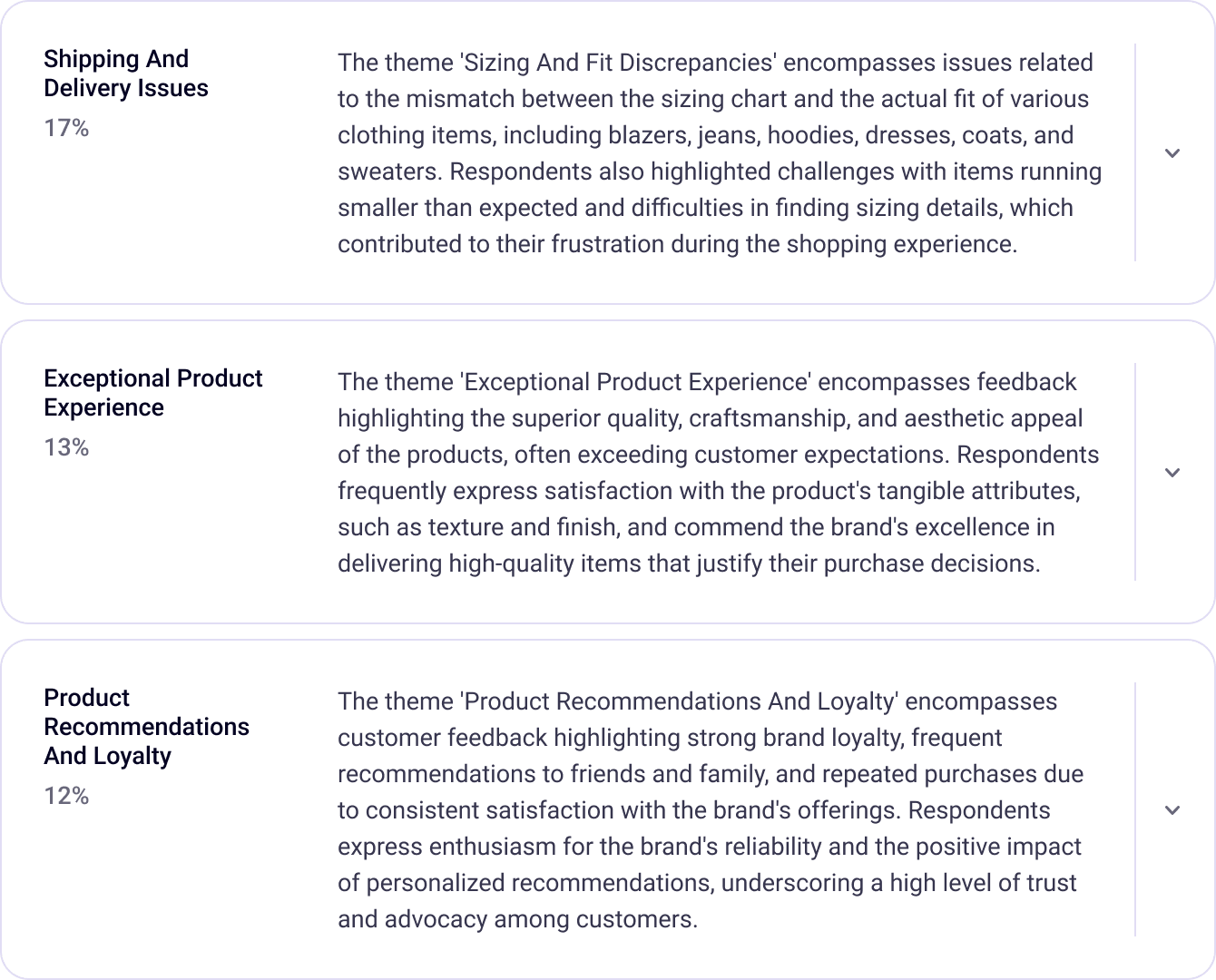
From there, sentiment is applied to each theme individually. This approach is known as Aspect-Based Sentiment Analysis (ABSA). A single comment can carry completely different sentiments depending on the topic. Someone might write "the product is amazing but delivery took forever," which is positive for product quality and negative for shipping at the same time.
This gives you a much richer picture than a simple positive/negative/neutral split. You can see exactly where you're winning and where you're falling short, by topic.
Step 5: Find Trends and Patterns
It's also worth understanding the difference between two types of sentiment research. Ad hoc research is a one-time snapshot used to answer a specific question like, "How did people respond to our new campaign?" Trackers are ongoing and measure sentiment continuously over time, giving you a baseline so you can spot when something shifts. Both are valuable, but they serve different purposes.
With ad hoc research, you're typically looking at two things in that snapshot:
- The overall sentiment breakdown: How positive, negative, and neutral responses are distributed across your data.
- Topics and keywords driving the strongest reactions: Which themes are generating the most emotional responses? If "customer service" is consistently triggering negative sentiment while "product quality" stays positive, that tells you exactly where to focus.
With a tracker, you get all of that, plus the dimension of time:
- Sentiment over time: Are people becoming more positive or more negative about your brand month over month? A sudden dip in sentiment often ties directly to a specific event, a product launch that didn't land, a shipping delay, a PR moment, or a policy change.
Challenges of Social Media Sentiment Analysis
Sentiment analysis is a powerful tool, but it's not perfect. Here are a few limitations worth keeping in mind:
- Nuanced language is hard to read accurately: Automated tools struggle with sarcasm, irony, and slang. Most advanced tools are getting better at this, but it's still worth a manual check on anything high-stakes.
- You don't control the conversation: People on social media talk about what they want to talk about, not necessarily what you want to know. Your audience might not be discussing your new product launch at all, or they might be having the conversation on a platform you're not monitoring. There's also no guarantee you'll know a conversation is happening until after it's already spread.
- It represents the loudest voices, not all voices: People who feel strongly, whether extremely positive or extremely negative, are far more likely to post than people who had a perfectly fine experience. That means your data can skew toward the extremes and may not reflect the silent majority of your customers.
As Vishakha Mathur, communications expert and vice president at SKDK, puts it:
"Internal visibility can distort perceived scale. What feels like a major reputational risk is often just a localized pocket of conversation, not something meaningfully shifting overall brand sentiment."
- Collecting the data is harder than it looks: Social media data is spread across dozens of platforms, many of which have private or closed groups that can't be accessed. Pulling it all together in a clean, usable format often requires technical tools and some patience.
Top Sentiment Analysis Tools (2026)
Here are the top tools for social media sentiment analysis for brand managers, market researchers, and enterprise teams.
| Tool | Best for |
|---|---|
 |
Enterprise-level brand monitoring and deep social listening |
 |
Social media managers wanting sentiment built into their publishing workflow |
 |
Market researchers who need deep content analysis of social media sentiment and conversations |
 |
Real-time trend detection and visual content analysis |
 |
Small to mid-sized teams needing straightforward brand monitoring across the web and social |
 |
Organizations needing deep NLP and sentiment scoring across large volumes of unstructured text |
 |
Researchers and enterprise teams combining social sentiment with broader customer experience data |
Need more than sentiment scores? Blix turns social data into deeper insights.
FAQ
Here are answers to common questions about social media sentiment analysis.
Yes, but it's best suited for spot-checking individual pieces of content rather than bulk professional analysis. Quality will not be high and it's not practical for processing thousands of social mentions at scale. There might also be some privacy concerns if you deal with sensitive data.
No. ChatGPT doesn't have direct access to live social media platforms and can't pull data from them. You'd have to manually export and paste everything in yourself, which isn't realistic at any meaningful volume.
Accuracy depends on the tool and method being used. AI-based tools generally perform better than rule-based ones, particularly with informal language, sarcasm, and slang.