As information becomes more accessible, trust and credibility become more valuable. The relevant market researcher will need to shift with the times, moving from producing more knowledge to making sense of it, grounding evidence in real human experience, and turning insights into decisions the organization can trust and act on.
Imagine a beverage company discovers that sales of a new product are 15% below forecast.
Until very recently, understanding why would typically require a multi-stage research process. Researchers would define the research question, select a methodology, commission or conduct the data collection, analyze the findings, and produce a report and recommendations.
Depending on the scope, a research project like this could cost tens of thousands of dollars, take several weeks to complete, and require significant effort from both internal teams and external suppliers.
Today, that process could look very different.
How AI Agents Could Turn Market Research Into a Continuous Loop
Instead of commissioning a separate research project, imagine giving the problem directly to an AI agent. It could independently formulate several hypotheses: perhaps the price is too high, the taste is problematic, the packaging is unattractive, the product is poorly positioned in stores, or consumers simply do not understand its differentiation.
The agent could propose different methodologies: a survey of 2,000 consumers, 50 in-depth interviews, analysis of online reviews, or an experiment testing the impact of price and packaging. It could use simulations and synthetic data to assess which methodology is likely to provide the most reliable answer. It could then run the research, collect the data, and analyze the results.
Suppose the agent codes open-ended survey responses and discovers that the central problem is not price, but that 62% of consumers do not understand what differentiates the product.
It could then test alternative messages, check whether the findings hold across different samples, and produce a recommendation to change the messaging on the front of the package.
And the research would not necessarily end there: The agent could independently launch an A/B test with different packages or messages, monitor sales, analyze the results, and use the new data to determine whether another change should be made.
In this way, the agent is not merely executing a research plan. It turns research into a continuous loop: Research, Decision, Action, Measurement and New Research.
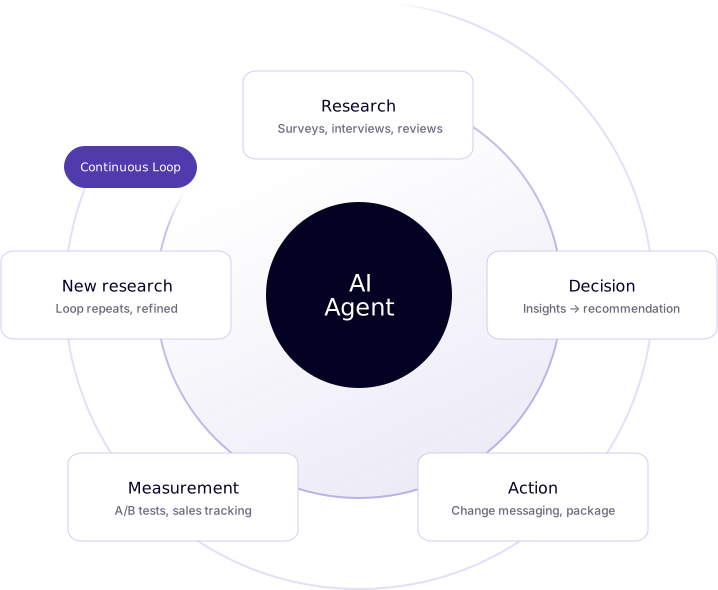
Not every part of this process can be fully automated today. But the direction is increasingly clear.
What is the Value of a Market Researcher When Answers Become Cheap?
So what does the future look like for market researchers? And what is their role in a world where AI agents can increasingly manage this entire process?
In my view, this can be distilled into three principles.
1. Take Full Responsibility for the Knowledge Creation Process
As information becomes cheaper, trust and credibility become more valuable.
Within knowledge-intensive organizations, the person who can take genuine and deep responsibility for how knowledge is created becomes an asset. AI Agents can generate new knowledge at unprecedented speed, but they will not always be able to explain where that knowledge came from, how reliable it is, or why the available information led to a particular conclusion.
This is related to what is often referred to as the black box problem or lack of interpretability. We can observe the input and the output without necessarily understanding the internal process that produced the result.
The researcher is therefore responsible for the explainability of the research, regardless of how many agents are involved or how complex the research process becomes. And as the technology advances, this principle becomes harder to fulfill, making the person who possesses this capability increasingly valuable within organizations.
The new researcher does not necessarily need to understand every internal operation of the model. But they need to be able to say: "I know why I trust this conclusion."
2. Keep AI Research Grounded in Real Human Evidence
AI can come up with synthetic data, ideas, and hypotheses, but it can't replace real contact with the world. To understand how people behave and how reality is changing, you still need to talk to real human beings, observe them, and test things in real life. Amazon’s Customer Obsession and human-centered research are therefore still essential, and tight feedback loops become even more important when everything moves faster.
This matters especially when your research question requires genuinely new evidence. Someone still has to observe, interact with, or test something in the real world. New experiences have to actually happen before AI (or anyone) can learn from them. This matters a lot when you're researching something brand new, like an innovative product that doesn't have a track record yet.
There's a second issue too, the data itself may not represent the population you're trying to understand. If something isn't in the data, AI simply doesn't know it exists. And if the data is biased, AI will pick up that bias too.
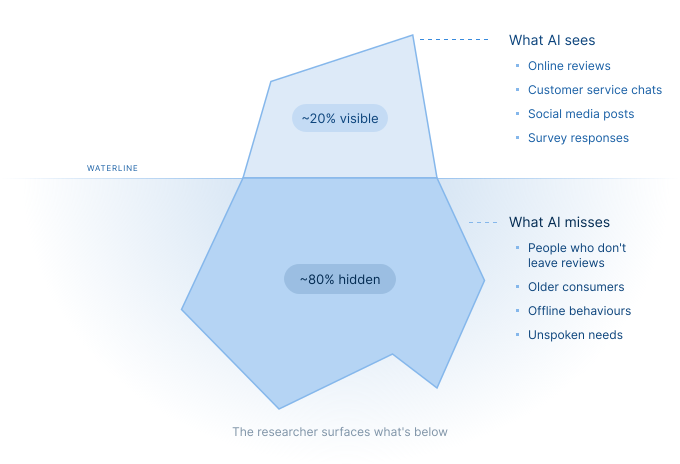
Here's an example: say a company wants to know why people aren't buying a certain product. They feed an AI system millions of reviews, customer service chats, social media posts, and old surveys. The AI notices that 80% of the conversations are about price and ease of use, and concludes: "These are the two big factors driving purchase decisions."
Sounds reasonable, but what if there's a whole group of people barely showing up in that data? Older consumers, for example, who rarely leave online reviews in the first place.
That's where the researcher comes in: making sure the conclusions actually reflect a more holistic human experience, and that they're true to the population the research is supposed to represent, not just the people who happened to leave a paper trail.
3. Turn Research Into Decisions
The third principle represents, in my view, a deeper and more fundamental change in the nature and capabilities required of market researchers today. It has to do with the ability to embed relevant knowledge within the organization in ways that actually support decisions.
The ability to conduct research quickly has improved dramatically. But the same is true for other functions within the organization, whether the output is code or a policy plan. Organizations are moving faster than ever, and the boundaries between different roles are becoming increasingly blurred. Against this backdrop, a fundamental capability of applied researchers is becoming even more important: the ability to connect research to real-world decisions.
The SMART Framework: Turning Research Into Action
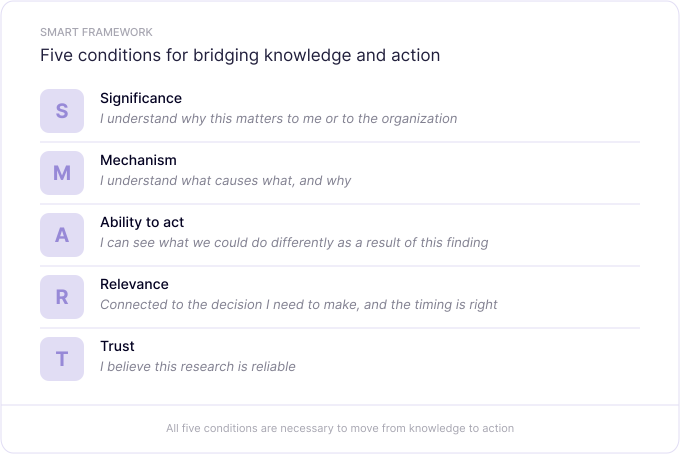
Research should always be logical and rational, but research alone is almost never enough to drive action. Decision-making is a complex human process shaped by a network of trust, values, interests, emotions, experience, biases, and organizational context. The following conditions are necessary (though not sufficient) to make the leap from knowledge to action. Over the years, I've distilled it down to five conditions which form the SMART Framework:
- Significance: I understand why this matters to me or to the organization
- Mechanism: I understand what causes what, and why
- Ability to act: I can see what we could do differently as a result of this finding
- Relevance: This is directly connected to the decision I need to make, and the timing is right
- Trust: I believe this research is reliable
The paradox is that as the cost of producing research falls, the risk grows that organizations will produce more knowledge than they are capable of actually absorbing and acting upon.
The value of the researcher may therefore shift from producing information to managing the transition between knowledge, trust, and decision-making. The ability to observe a changing reality and determine whether the object of research is still relevant, what has changed, and who needs to hold which piece of information cannot yet be fully automated.
This is becoming a core capability for market researchers. It is built on instincts that researchers have always developed through their profession, but its relative importance within the overall mix of skills required is changing.
The Future of Market Research Is Still Human-Centered
When research becomes cheap, fast, and autonomous to produce, the market researcher's job doesn't just evolve, it changes shape. What used to take up most of the function falls away, and what's left is the part that mattered most all along: framing the right questions and turning answers into decisions. The gain is real, but so is the shift, and the researcher who thrives is the one who moves with it.
The value of the researcher may no longer lie primarily in the ability to collect more information, analyze more data, or produce a better report. Instead, it may lie in the ability to determine what is worth knowing, whose voices need to be heard, what is worth believing, and what should be done with what we have learned. In this world, the researcher becomes less of a producer of knowledge and more of an authority on how that knowledge should be questioned, interpreted, and applied.
Perhaps this is the real meaning of Human-Centered Research in the age of AI: It is not about insisting that humans continue doing work that machines can already perform; It is about ensuring that even when machines perform most of the work, humans remain at the center of the questions, the evidence, and the decisions.