- Brand tracking is a means of measuring how consumers perceive your brand, with data collected in waves to assess the health of a brand over time.
- The research enables consumer insight teams to analyze campaign performance, predict future trends and benchmark against competitors.
- Brand tracking studies can monitor brand awareness, purchase intent, brand loyalty, advertising recall and share of mind.
- Successful brand tracking research relies on alignment with business priorities, well-designed sample and quotas, strategic fieldwork scheduling, a strong, consistent questionnaire and analysis that focuses on a few key metrics.
Most brands run some sort of brand awareness research, but many brands don’t make the most of what their tracker tells them. Research from Gartner shows 57% of brands run brand health tracking studies, but only 21% gain actionable insights from the research.
Running a successful brand tracker depends on clear objectives, disciplined survey and sample design, and analysis that considers all the angles. Well-designed brand tracking market research shows where you stand in the market and what trends are emerging.
In this guide, I draw on almost 20 years of experience in market research, including running major brand tracking studies, to explain what brand tracking is, what it measures, and how to design an effective survey. I’ll also share practical advice on turning brand tracking results and open-ended responses into actionable insights, while avoiding common mistakes.
What is brand tracking?
Brand tracking is an ongoing study investigating how an audience or group of consumers perceives a brand. The research is ongoing, with data gathered either continuously, or in waves. While a single, standalone brand health study indicates the health of a brand at a fixed moment, a tracker can reveal changes in awareness, perception, loyalty, and purchase intent over time. It can also indicate direction of travel, helping brands to monitor KPIs, predict and plan for future trends, and address issues as they arise.
Unlike customer feedback market research, brand tracking requires a wide, general sample. Surveying customers only can skew results and hide how you compare with other brands.
What are the advantages of brand tracking?
Some advantages of carrying out brand tracking research include:
- Brand tracking indicates possible future trends and the health of the brand, while sales data can only provide insights on past performance.
- Waves can be timed to monitor new campaigns, launches, or rebrands, and measure how they affect unaided awareness and brand perception.
- It allows for a strategic approach to research and development, with a dashboard of consistent metrics that can inform key business decisions.
- Brand health tracking offers the opportunity to benchmark against competitors over time.
What does brand tracking measure?
There is a whole suite of key metrics brand health tracking can provide insights on, including:
- Unprompted and prompted awareness: Do consumers recall your brand spontaneously, and are they familiar with it when prompted?
- Consideration: Would consumers consider using your brand, or purchasing your products?
- Brand preferences: Which brands within the market do consumers prefer?
- Usage: Are respondents currently using the brand, or buying its products?
- Advocacy: Would people recommend the brand to friends or family?
- Perceived quality and value: To what extent do consumers believe the brand makes quality products and represents value for money?
- Brand association/loyalty: To what extent do consumers relate to the brand, and/or how loyal are they to it?
- Advertising recall: Can consumers recall any advertising from the brand, either prompted or unprompted?
- Purchase intent: Are respondents considering buying from the brand, now or in the future?
- Positioning compared to other brands: How does the brand compare to its key competitors in the market?
7 steps to designing a brand tracking survey
The choices you make before you start your brand tracker are critical, as these will form the foundation of your brand tracking research for years to come. Follow these seven steps to creating your brand tracking survey:
1. Start with the business questions you need to answer
Firstly, think about your key business questions, then decide how your tracking survey can help you answer them. Any research project requires up-front thinking about what you want to gain and how the research will inform your business strategy. Starting with a list of questions without understanding why you’re asking them, or what you’ll do with the data, risks leaving a huge amount of valuable insight on the table.
2. Define your audience and design your sample
Your sample is critical to the success of your tracking study. An effective brand tracking study will deploy a wide sample to truly understand your brand’s position in the market. You’ll want to hear from current customers, consumers who are familiar with your products and those of your competitors, and respondents who are currently unfamiliar, or unlikely to use your products.
3. Choose a focused, strategic set of metrics
It’s critical not to overcomplicate your brand tracking market research or aim to answer too many key business questions. Define a manageable set of KPIs that will provide valuable insights to teams across the business whenever you conduct a wave of research.
4. Write a strong, relevant questionnaire
With a tracking study, you’ll be running the same questions over and over, to create comparable results across waves, so getting your questionnaire design right is one of the most critical steps. Draft your questionnaire, test it, and redraft it to ensure your survey answers the questions you want it to. Once you’ve written your questionnaire, you’ll want to make as few changes as possible to your core question set between waves.
Use a mix of questions to gauge spontaneous and prompted recall, scales to identify subtle shifts over time, and customer sentiment questions such as Net Promoter Score. Don’t neglect the value of open-ended questions to give you deeper insights into the 'why' behind respondents’ perceptions of your brand.
5. Set quotas to ensure a balanced, representative sample
Keep the sample representative of your population and keep the structure of the sample consistent across waves. Consider the smallest segment of audience you need to read, and design quotas to deliver a large enough sample for robust analysis on each subgroup.
6. Choose a schedule around your strategic objectives
Build your research schedule around strategic objectives or to coincide with key reporting dates. Decide whether you want continuous data collection or to run your tracking survey in waves. If you’re planning major events, product launches, or new campaigns, consider these before you go to field, and make any necessary adjustments to your survey.
7. Build quality controls for data quality and consistency
Quality controls are essential to creating robust, reliable brand tracking research that stands the test of time. Include a change log from the outset to track any changes to your questionnaire, sampling, or fieldwork schedule, and consider introducing safeguards such as duplicate prevention, geo-fencing, and low-quality response flagging.
How to gain actionable insights from your brand tracking study
Follow these quick tips to ensure you get the strongest, most actionable insights from your brand analytics:
- Link each metric to a strategic target with a named owner who’s responsible for it. This spreads responsibility and ensures your tracking study is relevant and valued across the business.
- Benchmark against competitors, not just previous waves. By doing so, you’ll better understand your position in the market and spot opportunities to gain a competitive advantage.
- Look for movement across several waves in your brand analytics before declaring something a trend. Anomalies can occur from wave-to-wave, so be patient, don’t jump to conclusions, and hold back from making decisions on findings from one or two waves of your study.
- Combine quantitative and qualitative responses to understand not just how something changed, but why. Be consistent with verbatim coding, using AI-powered coding software like Blix to quickly identify themes and seamlessly code open-ended data into valuable quantitative insights.
- Relate findings to business outcomes and real-world sales data. Understanding how brand perception is affected by, and informs, all these things will truly add value to your tracking study.
- Keep a module free for live business questions, so you can be agile in gathering data on pressing issues. While you’ll want the core of your questionnaire to remain consistent between waves, saving space for a regular rotation of pressing questions can deliver valuable insights and keep your tracking survey fresh.
- Set a review schedule alongside your research to close the feedback loop and maintain the relevance of the tracking study across waves. Although consistency is key, it’s also vital to reflect on the survey regularly to ensure it’s still meeting key business requirements.
Measuring unprompted awareness: the key indicator of brand health
Of all the metrics a brand tracking study can provide, unprompted or unaided awareness is one of the most powerful. The proportion of consumers who can spontaneously name your brand in a category indicates how dominant your brand is in that sector. High levels of unprompted awareness for your brand suggests the brand is deeply embedded, rather than just casually associated with its category.
Tracking studies can report several measures of unaided awareness:
- Top-of-mind awareness: the first brand the respondent names, showing which brands are at the front of mind when a respondent thinks of a category of products or services.
- Total unaided awareness: the share of respondents who name your brand at any point in their answer, in any position.
- Share of mind: your brand’s mentions as a proportion of all brand mentions in the category, showing how much mental space your brand holds relative to competitors.
A brand could score highly on one measure of unpromoted awareness, and poorly on another, so you can gain a wealth of insights on your brand’s position in the market from respondents’ unaided brand recall. For example, a high total unaided awareness score paired with a low top-of-mind score suggests people know your brand but don’t think of you first within your product category.
Coding unaided brand awareness responses
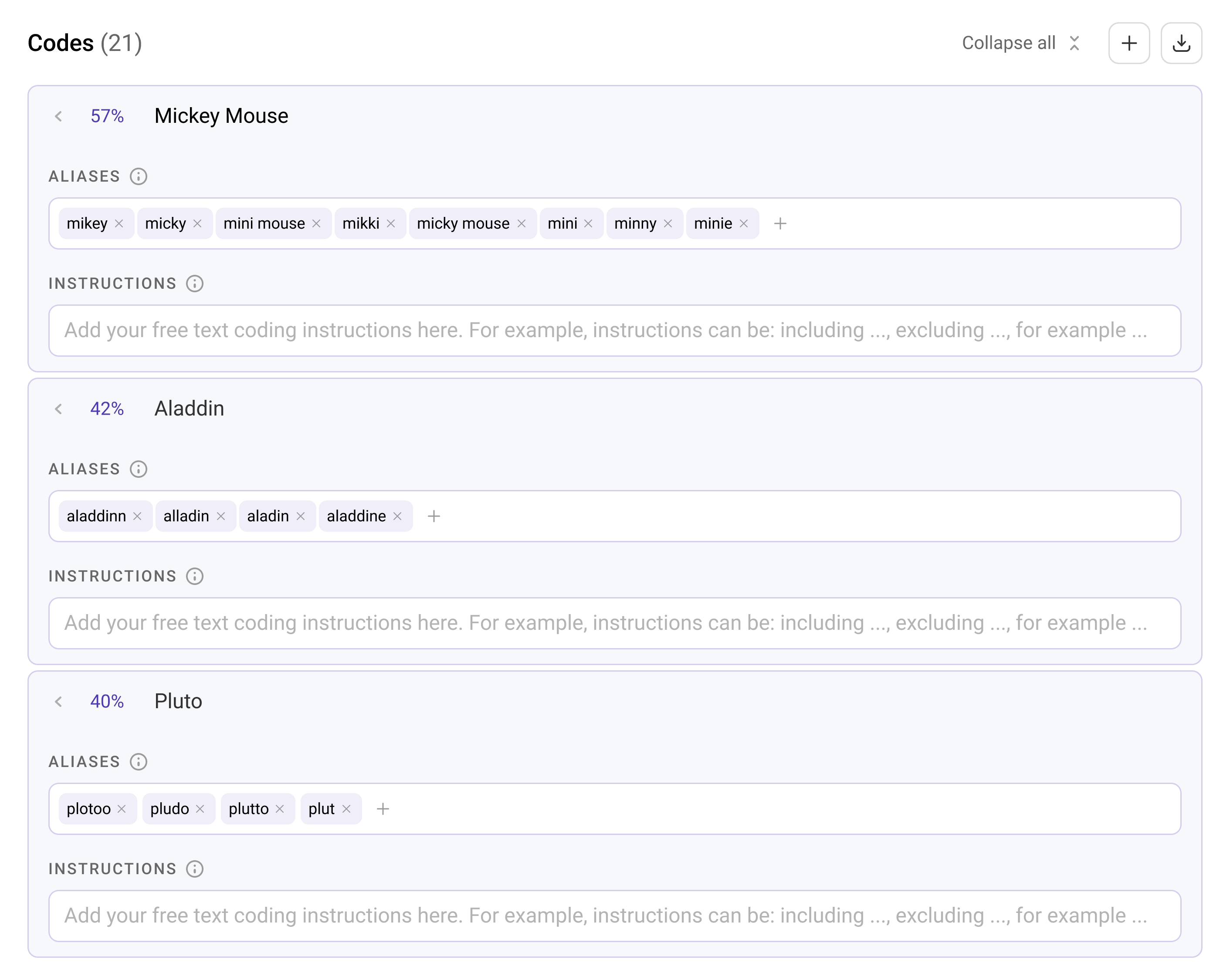
Coding responses is the real challenge when seeking meaningful insights from unprompted brand awareness questions. Respondents type their answers in free text, so your data could be affected by any of the following:
- Spelling mistakes: Respondents typing in their answers make spelling errors more likely.
- Abbreviations or nicknames: If your brand is known by a nickname or an abbreviation, it can be difficult to identify these mentions.
- Multiple languages: Tracking studies running across different markets can suffer from translation issues when it comes to coding open-ended text.
- Ambiguity: Respondents may list product names, parent companies or generic terms for products that don’t neatly fit a brand.
To make the most of your unaided awareness data, you’ll need to code your open-ended survey responses accurately. Failing to turn these qualitative responses into quantitative data is where tracking study owners can miss valuable insights.
Manually coding open-ended unprompted awareness responses means reviewing your dataset row-by-row. It involves building a master brand list that includes every known brand and applying it identically each wave, reviewing unmatched responses by hand, and using native speakers or translation tools and services for international trackers. For large tracking studies, this is time-consuming, costly and repetitive.
This is where AI-powered coding tools like Blix can help. Blix automatically identifies different spellings, abbreviations, and variations of brand names, generates a codebook even when your data contains hundreds of brands, and codes responses consistently. It also supports global tracking studies, analyzing responses in any language or mix of languages.
Simply upload your data, and Blix turns your open-ended brand awareness responses into quantitative data ready for analysis, with just a click of a button.
5 Common brand tracking mistakes and how to fix them
Avoid falling into the trap of these common tracking study mistakes, and follow these fixes to ensure your survey remains relevant and valuable to the business:
- Changing questions too frequently: chopping and changing your questionnaire will undermine your insights, making waves incomparable and certain types of analysis redundant.
- How to fix it: Keep a core of questions consistent between waves, focusing on the most relevant business questions. Retain a module of your survey for one-off questions.
- Bloated questionnaires: You might want to throw everything at your tracking study, or feel pressure from other departments to keep adding questions.
- How to fix: Design your questionnaire around a few key business objectives and review your questionnaire annually. If colleagues wish to add something to your questionnaire, be clear that something needs to be removed to make space.
- Weak or underpowered sample: If your sample size is too small or quotas are poorly designed, you’ll struggle to be able to analyze your data in the way you want.
- How to fix: Size each wave for the smallest segment you need to analyze, and treat quoted margins of error as a floor, not a target. Keep quotas and weighting constant, and apply data quality checks to every wave.
- Under-valuing open-ended responses: There’s a risk that raw open-ended responses can sit untouched in your dataset, offering nothing to your analysis. Coding open-ends and free text responses can be a laborious, tedious process, but if you neglect them, you’re leaving consumer insights on the table.
- How to fix: Blix’s open-ended survey data analysis tool can code your free text responses in seconds. This can enable you to carry out quantitative analysis of open-ended text feedback. Blix automatically generates themes from open-ended survey responses in one click, using AI specifically designed for this purpose.
- Lack of a coherent strategy: It’s easy to let your tracker become a tick-box exercise. Weak executive buy-in can lead to results being easily forgotten or the whole study becoming a side project.
- How to fix: Create a short tracker charter covering its objectives, the decisions it informs, metric owners, targets, review schedule, and how results inform planning. Keep your tracking study as a standing item at executive meetings to ensure it remains front-of-mind.
Brand tracking FAQs
A tracking survey is a recurring research study that measures consumers’ awareness, perception, loyalty, and usage of a brand. The survey gathers data either continuously or in waves, with a consistent question set, allowing brands to measure key metrics over time, rather than providing a snapshot at a single point in time.
Brand tracking is the process of measuring how consumers perceive, recognize, and interact with a brand over time. Instead of gathering data in a one-off study, brand tracking enables companies to survey consumers over time to identify trends and changes in the way people view their brand.
Brand metrics include various measurements that organizations can use to assess the health and success of their brand. They include unprompted and prompted awareness, brand sentiment, brand associations, share of voice, customer satisfaction, Net Promoter Score, purchase intent, brand preference, and advertising recall.
You can measure brand recognition in several ways. Learn whether respondents mention your brand unprompted, by asking questions such as, “When you think about [product or service category], which is the first brand that comes to mind?”
Alternatively, you can test visual brand recognition by showing some brand visuals, such as a logo, and asking if the respondent knows which brand the logo represents. You can also check prompted awareness by asking, “Have you heard of [brand name] before today?”
The 3-7-27 rule in branding provides a rough guide to how much exposure a brand needs before a consumer is likely to move to a purchase. The rule of thumb suggests a typical consumer requires three brand exposures to notice the brand, seven to remember the brand, and 27 to become familiar, trust the brand, and consider purchasing.